Force vectors
A force is not a number. Two 100 N pulls on the same bracket can add to 200 N, to nothing at all, or to anything in between, what decides is where they point.
When we talk about scalars, we could be refering to mass, temperature, the length of something , all that is needed is the number and the unit and you are done. A force is not like that. Telling someone a cable is carrying 500 newtons is useless until you also say which way it pulls and where it grabs the load. That extra information is what makes a force a vector.
What a force carries
Every force is composed of three things: a magnitude (basically how much the force is, refer back to the 500N example before), a direction, and a point of application. Draw the direction out through that point in both senses and you have the line of action, the infinite straight line the force acts along.
For a rigid body, a force may be slid anywhere along its line of action without changing its external effect. Push a crate at the handle or at the far edge along the same line and the reactions at the floor come out identical. This is the principle of transmissibility, and it is what lets you move forces around a free-body diagram to wherever the algebra is easiest. It holds only for external effects: the internal stress in the crate very much depends on where you actually pushed.
A force acts at a point.
Adding forces
Two forces acting at a point combine by the parallelogram law. Draw them from a common origin, complete the parallelogram, and the diagonal is the resultant. The same construction drawn head to tail is the triangle rule, which is usually faster by hand.
Solve the triangle with the law of cosines. If \(\theta\) is the angle between the two forces:
Two sanity checks fall straight out of that expression. Forces pointing the same way, \(\theta = 0\), give \(R = F_1 + F_2\). Forces directly opposed, \(\theta = 180^\circ\), give \(R = |F_1 - F_2|\), which is zero when they match. Everything in between is smaller than the naive sum, which is the whole point: adding magnitudes overstates what the structure actually feels.
The direction of the resultant comes from the law of sines on the same triangle.
Two forces pull on the same point.
Cartesian components
Sketching a triangle for every pair of forces does not scale past about three of them. Instead, resolve each force once onto a set of axes and never draw a triangle again:
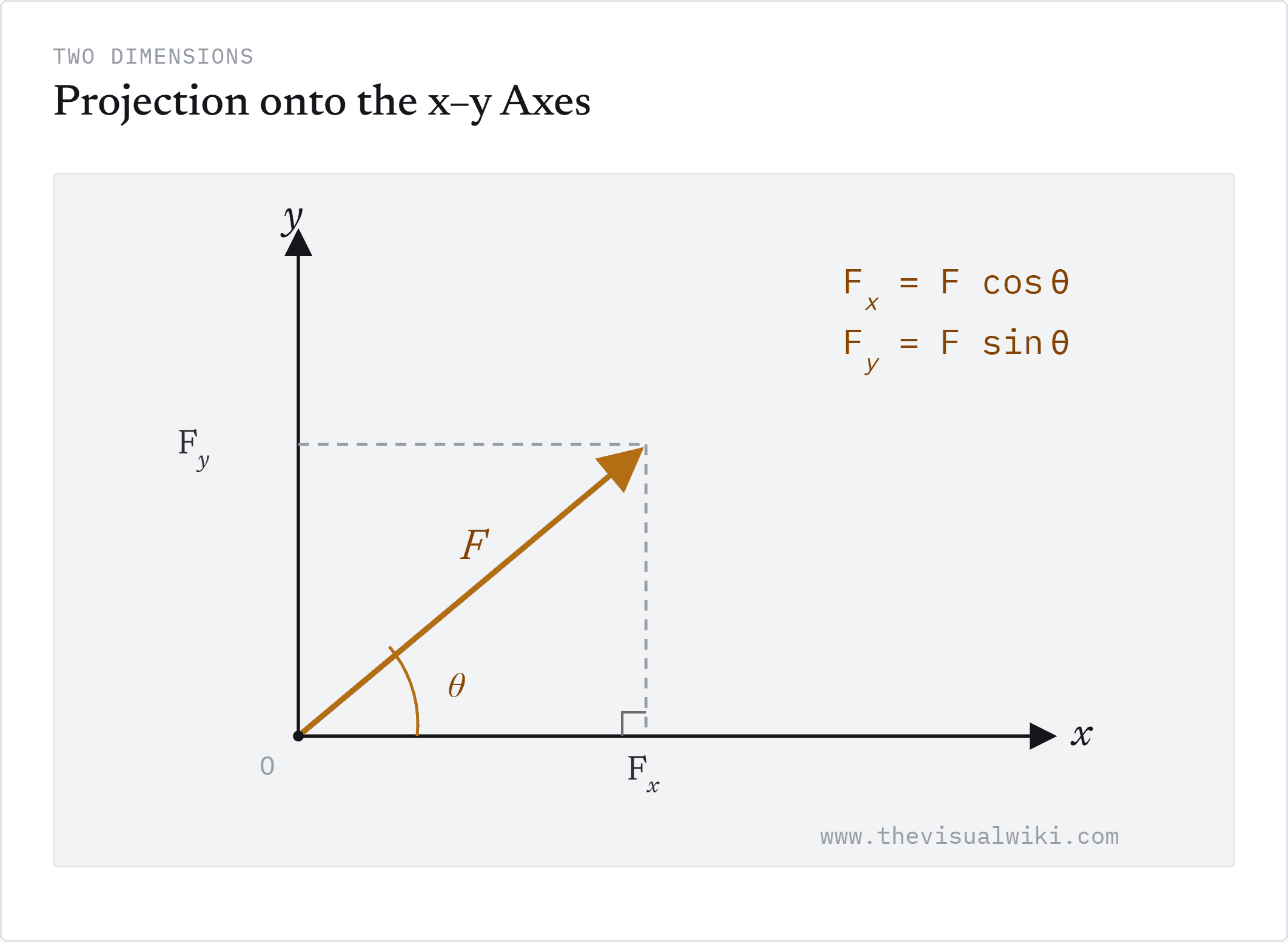
In components, addition is componentwise — sum the \(x\) terms, sum the \(y\) terms, sum the \(z\) terms:
and the magnitude follows from Pythagoras in three dimensions:
Direction is reported with the coordinate direction angles \(\alpha\), \(\beta\), \(\gamma\) that the force makes with each axis. Their cosines are just the normalised components:
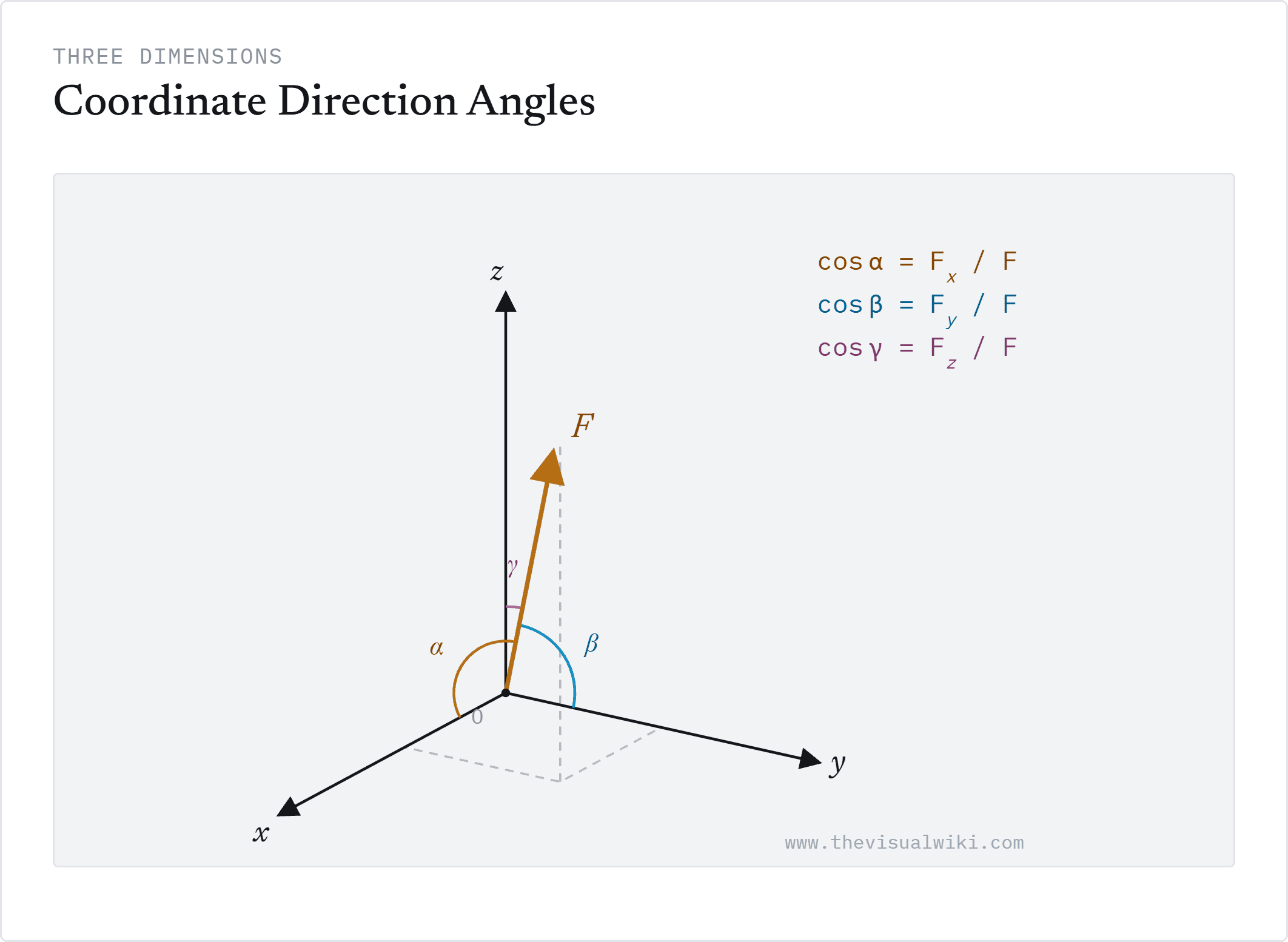
Those three are not independent. Squaring and adding them gives
so two of the angles fix the third — a useful check on any answer, and a common exam question in its own right.
Drop the force onto the x axis.
Forces along a line
In a real structure you rarely know the angles. You know coordinates: a cable runs from bracket \(A\) to anchor \(B\), both of which you can read off the drawing. The position vector from A to B is the difference of their coordinates,
Divide it by its own length and you get a unit vector: direction with the size stripped out. Multiply that by the scalar magnitude and you have the force.
This is the workhorse of three-dimensional statics. Geometry supplies the direction, and the unknown you carry through the equilibrium equations is a single scalar — the cable tension — rather than three separate components.
Subtract the endpoints to get the vector along the cable.
Projections and the dot product
The last piece is asking how much of a force lies along some other direction: the pull along an inclined member, the part of a wind load that acts down a roof. That is the dot product,
which also runs backwards to give the angle between two vectors. Dot a force with a unit vector and you get the scalar component of the force in that direction, \(F_u = \mathbf{F}\cdot\mathbf{u}\). Subtract that piece off and what remains, \(\mathbf{F} - (\mathbf{F}\cdot\mathbf{u})\,\mathbf{u}\), is the perpendicular component.
A dot product of zero means the vectors are perpendicular, which is the cheapest perpendicularity check you have and worth reaching for whenever a problem hands you two directions and asks whether one does any work along the other.